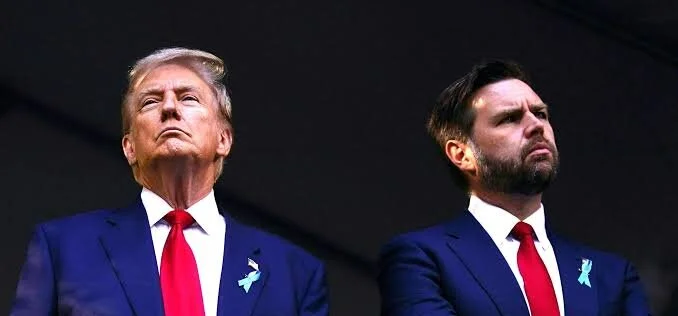
Report examines JD Vance's diverging stance from Trump on Iran war
A Mehr News analysis says US Vice President JD Vance has recently taken positions on a war with Iran that differ from President Donald Trump's, possibly as part of Republican efforts to prepare him for the 2028 presidential race.
Published on 1 November 2026
SaveReport examines JD Vance's diverging stance from Trump on Iran war
A report by Mehr News examines recent statements by US Vice President JD Vance that appear to diverge from President Donald Trump's position on initiating or continuing a war with Iran. The report suggests that Vance's positions, including a recent message to Major General Mohsen Rezaei, Secretary of the Supreme National Security Council, may signal an intent by American Republicans to prepare Vance for the 2028 presidential race, regardless of the message's specific content or Iran's response.
According to the report, Republicans are seeking to groom a figure distinct from Trump for the 2028 election, facing a weakened base due to Trump's failed approach toward Iran and the party's potential defeat against the Democrats in congressional elections. Vance, as a vice-presidential candidate who has historically expressed skepticism toward foreign military interventions, could attract a specific segment of the electorate by voicing opposition to a costly and futile war against Iran. The report distinguishes between Vance's opposition to a prolonged, costly war and opposition to any form of military action against Iran. On October 17, 2026, Vance alluded to a divergence of opinion between himself and Trump regarding a potential war with Iran. During the 2024 election campaign, in a conversation with American comedian and critic Tim Dillon, he stated that a war with Iran would not be in America's interest and would entail an extremely heavy cost. On February 26, 2026, he told The Washington Post that the United States should avoid becoming mired in a years-long war with no clear end in sight and should instead favor a diplomatic approach. Nevertheless, Vance did not rule out the possibility of limited military action to prevent Iran from acquiring nuclear weapons.
The report notes that Vance seeks to appeal to the anti-war faction within the Republican Party while fearing that distancing himself too much from Trump could invite the president's wrath and cost him the support of Trump's loyal base. Vance is aware that if he defends Trump too fervently, he will fail to establish himself as a distinct alternative for the presidency. At the same time, his opposition to costly wars could be a tactical move by Republicans to help him forge a political identity independent of Trump. To counter Democratic narratives regarding Trump's alleged warmongering, the Republican Party might encourage Vance to criticize the prospect of a Trump-led war with Iran while remaining committed to the "America First" doctrine and opposing entanglement in protracted conflicts. The Republican Party's efforts to groom Vance have not gone unnoticed by the media; a report by The Guardian on October 24, 2026, suggests that his prominent role within the party may serve as a dry run for a potential presidential bid in 2028.
As the 2028 elections approach, Republicans will likely urge Vance to express his opposition to Trump and to America's hawkish, interventionist policies more explicitly and independently. By gradually distancing himself from Trump, Vance would aim to secure the support of Republican donors for a potential electoral bid. Republicans will likely frame any aggression by Trump against Iran as a unilateral, unauthorized action taken without the party's consent. According to a Reuters report from October 7, 2026, two-thirds of Republican candidates in critical House and Senate races have either diverged from Trump on certain policy issues or sought to diminish their association with him. In 12 out of the 62 races examined, disagreements regarding the war with Iran emerged as a central issue. The economic strain caused by the conflict, exacerbated by Iran's strategic management of the Strait of Hormuz, has fueled opposition among some Republicans concerned about rising fuel prices and the financial burden on households.
The report concludes that the heavy costs of the war for the United States, combined with the failure to achieve stated objectives, are the primary drivers behind the realignment of power within the Republican Party. According to Mehr News, the defeat of the United States and the Zionist regime, coupled with Iran's sustained national cohesion and military strength, serves as the primary motivation for Republicans seeking a way out of the current crisis and a means to distance themselves from Trump.
Source: Mehr News — Read original story