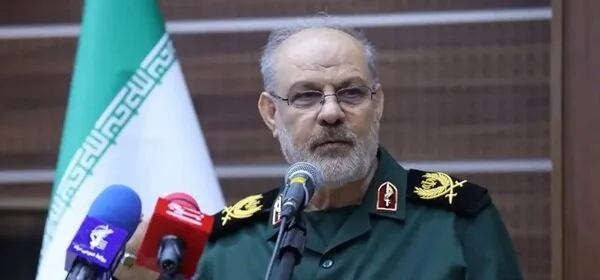
IRGC spokesman says US has no warships left in Persian Gulf
IRGC spokesman Brigadier General Hossein Mohebbi said the US has no warships in the Persian Gulf, a shift from previous decades. He warned of threats to global infrastructure if Iran is attacked.
Published on 11 August 2026
SaveIRGC spokesman says US has no warships left in Persian Gulf
Brigadier General Hossein Mohebbi, the spokesman for Iran's Islamic Revolution Guards Corps (IRGC), said on Tuesday that the United States currently has no warships in the Persian Gulf region. This marks a significant change from previous decades, as Mohebbi noted that during the Iran-Iraq War (1980-1988), the US had more than 100 warships in the Persian Gulf, and before the Ramadan War (also referred to as the 40-day war), it had 30 to 40 warships in the region.
Mohebbi stated that Iran's response during the recent conflict shifted the cost of the war back onto the opposing side, after the United States had sought to keep the consequences of war away from its own territory. He explained that following US strikes on Iran's South Pars gas field and the Asaluyeh energy hub, Iran launched long-range and precision missile attacks against infrastructure linked to the United States, Israel, and their allies. According to Mohebbi, these attacks made it difficult for Washington to continue the war at the same pace.
The IRGC spokesman issued a stark warning, saying, "If a threat against Iran emerges, hundreds of thousands of miles of energy transmission lines, thousands of power plants, and all American and non-American systems, and even global infrastructure connected to the Internet, would be at risk." He also commented on US military strategy, noting that "the US doctrine is based on fighting simultaneously on several fronts, while the reduction of arms poses a great threat to that country in the heart of the Pacific, against Russia and China, and also on fronts that the US considers a threat."
According to Mehr News Agency (MNA), Mohebbi's remarks highlight Iran's assessment of the regional military balance and its capabilities to respond to potential threats. The report did not provide further details on the specific timeline of the events mentioned.
Source: Mehr News — Read original story