Mecca Pact: A Threat or an Opportunity for Regional Security?
Turkey, Saudi Arabia, and Pakistan signed the Mecca Mutual Defense Agreement, aiming for collective deterrence. The pact could reshape regional security dynamics, with implications for Iran, Israel, and the US.
Published on 10 August 2026
SaveMecca Pact: A Threat or an Opportunity for Regional Security?
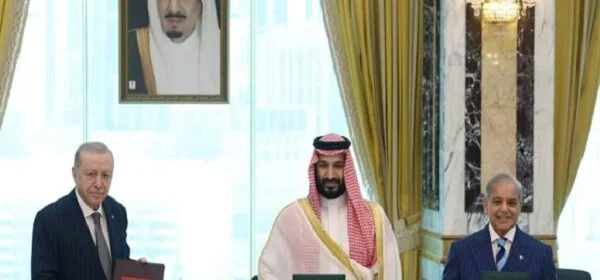
Turkey, Saudi Arabia, and Pakistan have signed a defense pact, dubbed the "Mecca Mutual Defense Agreement," aimed at strengthening deterrence against foreign aggression. The three countries have stated that the pact is not directed against any specific country and that its goal is to enhance collective deterrence. Turkey has described the agreement as a form of regional partnership to establish peace and stability, while emphasizing that membership in the Mecca Pact does not replace its role in NATO.
Analysts suggest that each signatory has distinct motivations. Pakistan, a nuclear power, views the pact as a means to bolster its position against India, its primary rival. By participating in this trilateral alliance, Pakistan also seeks to increase its geopolitical weight in the Islamic world and the region, especially after its mediating role between Iran and the United States. Turkey, despite being a NATO member, sees the pact as a way to increase its leverage within NATO and reduce its reliance on Atlantic allies, given its perception that Western security structures are inadequate for its needs. Saudi Arabia, which regards Yemen's Ansarullah movement as its most significant security threat, hopes the pact will help contain Yemen and address the naval blockade at Bab al-Mandab. Riyadh also anticipates that Turkey and Pakistan's involvement could deter Iran from attacking American interests on Saudi soil.
The recent military confrontation between the US and Israel against Iran, which ended in a clear failure for the aggressors, has prompted Arab countries, particularly Saudi Arabia, to reassess their security calculations and reduce dependence on the US. The billions spent on American weapons have proven insufficient to guarantee Persian Gulf security, and Washington's preference for Israeli interests over Arab interests has become evident. Turkey, after its setbacks in Syria and the loss of Golani, has lost trust in Washington. Pakistan, aware of the strategic US-India relations, also views the Mecca Pact as a step toward reducing security reliance on the US. If the pact serves as a precursor to a joint regional security mechanism, it could be seen as a positive development.
The Mecca Pact may also be interpreted as a regional alliance against the expansionist ambitions of the Zionist regime. Israeli Prime Minister Netanyahu's recent threats to Arab countries, including Lebanon, Syria, and Jordan, along with the assassination of Hamas leaders in Qatar, have alarmed regional states. Israel's efforts to annex Gaza and expand settlements in the West Bank have increased interest in an Islamic alliance against Israel. Among the signatories, Pakistan holds the most anti-Zionist stance, while Turkey has been a vocal opponent of Israel in recent months. Saudi Arabia has distanced itself from normalizing ties with Israel by supporting a two-state solution and an independent Palestinian state with al-Quds as its capital. Strengthening the anti-Israel approach among the pact's members could encourage other Muslim countries to join similar coalitions.
Since the Islamic Revolution, Iran has advocated for common regional security without foreign intervention. Regional leaders have increasingly acknowledged that the US is unreliable and that its military bases serve Israeli interests rather than regional stability. If the Mecca Pact aligns with Iran's vision of collective security, it could be a positive step. Iran, having demonstrated its military prowess against the US and Israel, can turn this potential threat into an opportunity through active diplomacy. Iran maintains good relations with Pakistan and Turkey and welcomes improved ties with Saudi Arabia. Its attacks on US bases are not directed at neighboring countries. This environment presents a favorable opportunity for a regional alliance to establish peace and stability, and if neighboring countries seize it, the region could see a brighter future. According to Mehr News Agency, these developments underscore the potential for a new security architecture in the region.
Source: Mehr News — Read original story