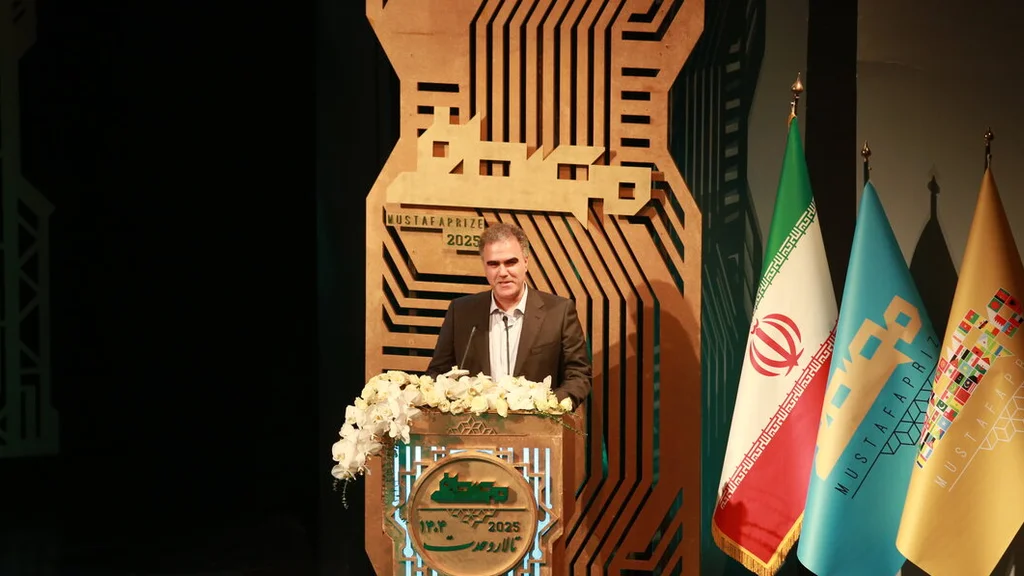
Iranian Researcher Vahab Mirrokni Wins 2025 Mustafa Prize for Locality-Sensitive Hashing Algorithm
Dr. Vahab Mirrokni, an Iranian graduate of Sharif University of Technology and MIT, received the 2025 Mustafa Prize for his Locality-Sensitive Hashing algorithm, which addresses the curse of dimensionality in big data and AI.
Published on 7 October 2026
SaveIranian Researcher Vahab Mirrokni Wins 2025 Mustafa Prize for Locality-Sensitive Hashing Algorithm
Many computing problems reduce to a simple question: given one item, how do you find the most similar item? In low-dimensional spaces, such as a line or a room, finding the nearest neighbor is straightforward. However, as dimensions increase—adding height, depth, and time—the task becomes impractical. Real-world data often exists in hundreds or even thousands of dimensions, a phenomenon known as the "curse of dimensionality." In such high-dimensional spaces, data becomes sparse, and the concept of similarity diminishes, making nearest-neighbor searches computationally infeasible.
Dr. Vahab Mirrokni, an Iranian researcher and graduate of Sharif University of Technology and MIT, proposed an innovative solution called Locality-Sensitive Hashing (LSH). This algorithm is now a popular hashing technique in big data processing and artificial intelligence. Mirrokni, a senior researcher at Google, was awarded the Mustafa Prize in 2025 for this achievement. The prize recognizes his contribution to addressing a fundamental challenge in the data age: finding valuable information within vast datasets.
The curse of dimensionality arises from the nature of modern data. For example, a 1000x1000 pixel color image is represented as three million dimensions, since each pixel has red, green, and blue values. Even after dimensionality reduction, hundreds or thousands of dimensions remain. In natural language processing, words are converted into numerical vectors of 100-300 dimensions, making a paragraph tens of thousands of dimensions. Genetic data, with the human DNA comprising about 3 billion base pairs, also produces extremely high-dimensional data when analyzed computationally.
In high-dimensional spaces, data points become almost equidistant, erasing the notion of similarity. Finding the nearest neighbor—a core task in data science, machine learning, and information retrieval—becomes nearly impossible. While metrics like Euclidean and Manhattan distances exist, traditional methods fail in high dimensions. Applications such as image retrieval, genetic similarity analysis, plagiarism detection, sentiment analysis, and recommendation systems all rely on finding similar data points, but their high dimensionality poses significant challenges.
Mirrokni's LSH algorithm offers a solution by hashing similar items into the same buckets with high probability, enabling efficient approximate nearest-neighbor searches. This breakthrough has broad implications for big data and AI. According to Mehr News, the Mustafa Prize, often referred to as the Muslim world's Nobel Prize, honored Mirrokni for his work, highlighting Iran's contributions to advanced computing.
Source: Mehr News — Read original story