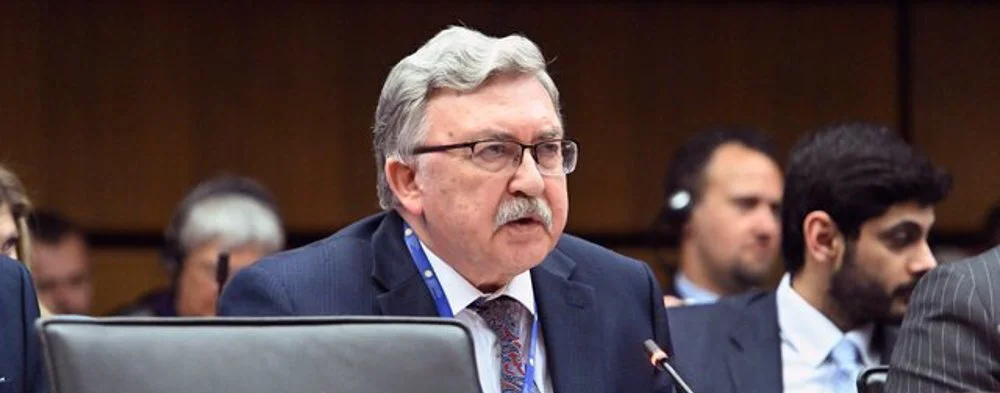
Russia warns against US push for anti-Iran IAEA resolution
Russia's envoy to the IAEA criticized US efforts to pass a resolution blaming Iran for attacks on its nuclear sites, calling it an attempt to shift responsibility from aggressor to victim.
Published on 8 June 2026
SaveRussia warns against US push for anti-Iran IAEA resolution
Russia’s Permanent Representative to international organizations in Vienna, Mikhail Ulyanov, on Monday criticized a reported US push for a draft resolution against Iran at the International Atomic Energy Agency (IAEA) Board of Governors. According to Reuters, the US is lobbying other countries to support a resolution requiring Iran to inform the agency about the fate of its nuclear sites bombed by the United States and Israel, as well as the enriched uranium stored at those facilities.
In a post on X, Ulyanov stated: “Indeed, the responsibility for aggression and its consequences cannot be transferred from the perpetrator to the victim. But some states most likely will try to do that in the course of current session of the IAEA Board of Governors. They want to put everything upside down.” He argued that the resolution attempts to shift blame for the war on Iran onto the Islamic Republic itself, which he described as the victim of illegal US-Israeli acts of aggression.
Iran’s Permanent Mission to international organizations in Vienna responded by stating that the current circumstances regarding Iran’s cooperation with the IAEA are a “direct consequence” of repeated attacks and threats against Iran’s safeguarded nuclear sites. The mission urged Board of Governors members not to allow the IAEA to become a tool for reducing the accountability of those responsible for attacks on Iran’s nuclear facilities. It warned that “a coercive and confrontational approach does not lead to cooperation and undermines the prospects for achieving a diplomatic solution.” The mission added that Tehran’s ties with the IAEA must be conducted within the framework of a law passed by the Iranian Parliament.
The US and Israel launched their first unlawful military assault against Iran in June 2025, lasting 12 days. A second invasion began in late February 2026 and ended in early April after 40 days. In both wars, the aggressors targeted Iran’s civilian infrastructure, including nuclear installations, in violation of international law and the Nuclear Non-Proliferation Treaty (NPT). Iran’s resistance and retaliatory operations forced the enemies to accept a ceasefire.
Following the first war, the Iranian Parliament in June 2025 unanimously passed legislation requiring the government to suspend all cooperation with the IAEA. Under the law, IAEA inspectors are not permitted to enter Iran unless the security of Iranian nuclear facilities and peaceful nuclear activities is guaranteed, subject to approval by Iran’s Supreme National Security Council (SNSC). The rationale was the IAEA’s politically motivated resolution, which paved the way for aggression, and the agency’s failure to condemn the terrorist assault. In September 2025, Iran and the IAEA agreed to a new form of cooperation, but two months later Tehran terminated the Cairo accord in response to an anti-Iran resolution by the Board of Governors.
According to Mehr News Agency, the report was originally published by Press TV.
Source: Mehr News — Read original story