Iran's Parliament Speaker Calls for Trade in National Currencies
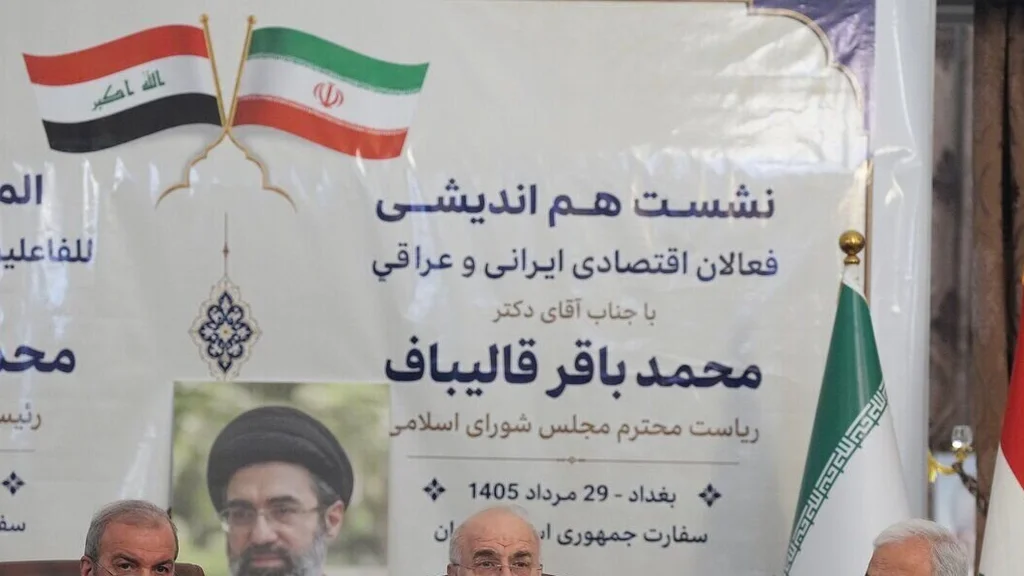
Iran's Parliament Speaker Mohammad Bagher Qalibaf, during a meeting with Iranian and Iraqi economic actors in Baghdad, called for trade in national currencies and rejected accusations that Iran seeks war.
Published on 21 August 2026
SaveIran's Parliament Speaker Calls for Trade in National Currencies
Mohammad Bagher Qalibaf, the Speaker of Iran's Parliament, addressed a gathering of Iranian and Iraqi economic actors at Iran's embassy in Baghdad, highlighting institutional problems faced by the private sectors of both countries. He announced plans for a follow-up meeting in Tehran with Iran's chamber of commerce to address these issues in a prioritized and practical manner.
Qalibaf emphasized that Iraq could benefit from the "intelligent, efficient and talented" workforce in Iran's border cities, and stressed the need for a proper economic and trade road map between the two nations. He rejected accusations that Iran seeks war, stating, "We have never been war-seeking. But as Muslims we believe in a principle of the Islamic Ummah: we do not allow anyone to trample our dignity and honour. We sacrifice our wealth and lives and defend our dignity and honour." He added that "no one appreciates peace more than those who have fought," and that diplomacy only has value when backed by readiness for war.
Qalibaf noted that Iran and Iraq had spent nearly half a century in a state of "neither war nor peace" and "both war and peace," a situation he blamed on foreign greed for the region's human, natural, and geopolitical capacities. He cited the geography of the Strait of Hormuz, the Persian Gulf, Bab al-Mandab, and the Suez Canal, saying that 75 percent of the world's maritime transport is in the hands of Muslim countries. "The enemy has come to plunder our resources and raw materials," he said.
The Speaker called for trade in national currencies, asserting that the era of American domination had passed. "The Americans and Israelis have understood they cannot defeat Iran and Iraq militarily, so they have entered cognitive and economic warfare, and now you are the soldiers and commanders of this field," Qalibaf told the business representatives. He warned, "No matter how much military power we have, if the people are hungry and we have no financial circulation, economic growth or national production, we will not survive." He described security and the economy as "two wings" of the same body, stating, "Investment requires security, and if security is not sustained by the economy, it will not be stable either."
Qalibaf also mentioned that the path from Iran and Iraq to the Mediterranean passes through the countries of the resistance, calling it "the heart of our geopolitical area and one of the great components of power and independence." During the meeting, eight Iranian and Iraqi private sector representatives raised banking, legal, and customs issues, and called for joint industrial zones, especially in Iranian border cities, the replacement of the dollar with dinar and toman in bilateral trade, private sector cooperation in rebuilding war-damaged areas, and stronger government support for cross-border business ties. According to Mehr News Agency, these discussions highlight the ongoing efforts to strengthen economic ties between Iran and Iraq.
Source: Mehr News — Read original story