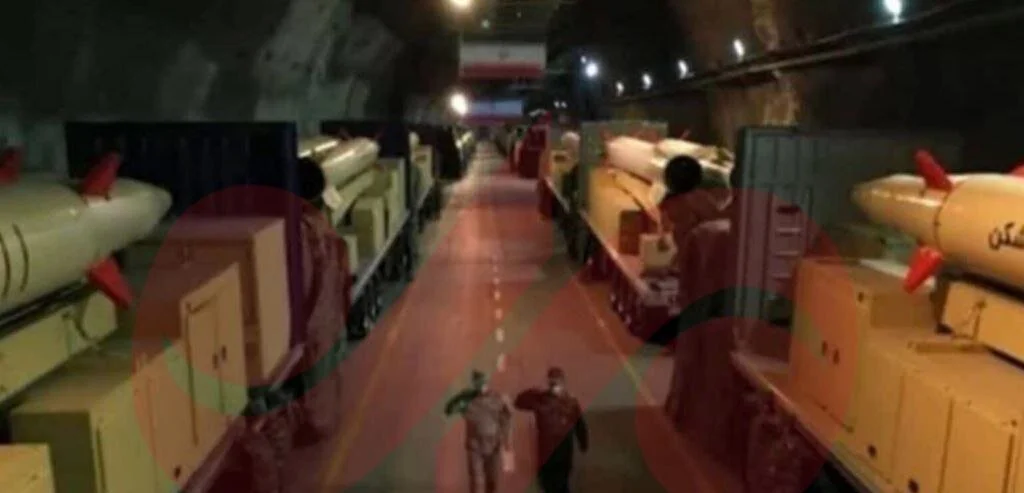
IRGC Spokesman Announces New Underground Missile City and Aerospace Achievements
Brigadier General Hossein Mohebbi said the IRGC Aerospace Force has moved missile and drone production underground and will unveil new capabilities if a third wave of confrontation occurs.
Published on 7 November 2026
SaveIRGC Spokesman Announces New Underground Missile City and Aerospace Achievements
Brigadier General Hossein Mohebbi, the spokesman for the Islamic Revolutionary Guard Corps (IRGC), said at a press conference on Saturday, held on the occasion of IRGC Aerospace Force Week, that the force has rapidly transferred its missile and drone production lines from the surface to underground facilities. He said this goes beyond underground missile storage complexes to the establishment of “missile production cities” deep beneath the ground. According to Mohebbi, indigenous expertise, Iran's vast territory and flexible production infrastructure would prevent adversaries from disrupting weapons manufacturing, even under heavy bombardment. He added that production continued steadily despite the enemy's assumption that Iran's missile stocks would eventually be depleted.
The IRGC spokesperson outlined the Aerospace Force's major achievements. He cited the development of indigenous aerospace technology and the localization of aerospace industries, which he said transformed Iran from an arms importer into a producer and exporter of advanced military equipment. He said indigenous expertise has been turned into industrial-scale production of military equipment, including the Shahed-136 drone, which he said has been copied by several countries, including the United States. He also cited exports of Arman missiles, the 358 drones and the 3rd Khordad air defense system. Mohebbi said the force relies entirely on domestic expertise and production rather than foreign weapons, imported components or reverse-engineering captured equipment. He also said the force maintains the ability to deploy short- and long-range, light and heavy weaponry and continue military operations despite intense enemy bombardment.
Mohebbi said the Aerospace Force had intercepted and destroyed more than 260 enemy aircraft and aerial vehicles during what he described as the US-Israeli war of aggression, including F-35, F-16, F-5 and F-18 fighter jets, as well as MQ-1, RQ-4, Orbiter and Lucas drones. He stressed that the figure did not include the achievements of the Iranian Army. He said flexible production capabilities ensure the uninterrupted manufacturing of missiles and drones under wartime conditions and heavy bombardment. He also said the radar cross-section (RCS) of missiles and drones has been reduced, enabling them to penetrate multiple layers of enemy air defenses and accurately strike their targets. He stated that advanced systems, including THAAD, had proved ineffective, while Patriot systems had also suffered failures.
Mohebbi said deterrence has been established through retaliatory strikes against enemy military and strategic infrastructure, including artificial intelligence and data-processing facilities, which he said forced the enemy to reconsider and halt further attacks. He also said the force has established close, organized cooperation with the country's universities, research institutions, scientific centers and industries. He said new military capabilities are being developed that he described as major surprises, which would be unveiled if a third wave of confrontation with the enemy takes place. He said these achievements would demonstrate the force's deterrent power and surprise the world. According to Mehr News, the remarks were made at a press conference on Saturday marking IRGC Aerospace Force Week.
Source: Mehr News — Read original story