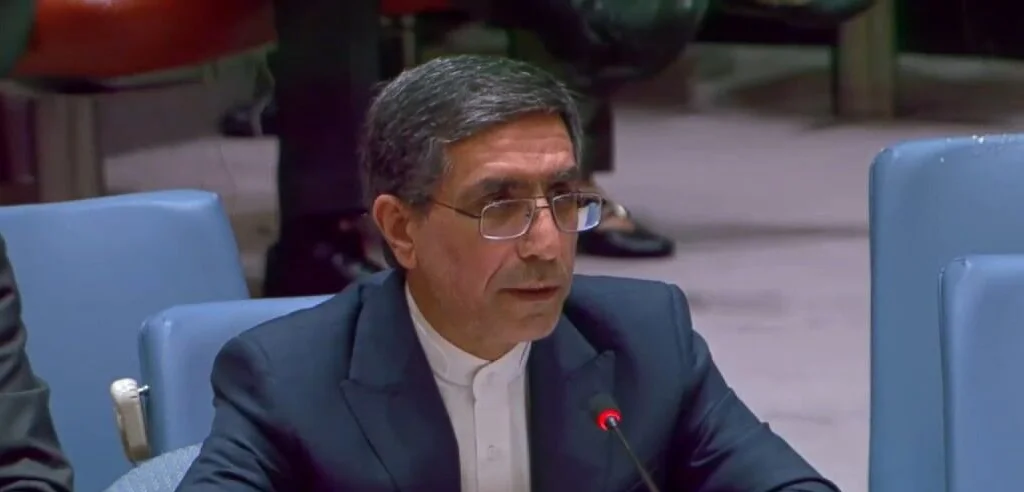
Iran urges UN to condemn US unilateral sanctions and naval blockade
Iran's deputy UN envoy called on the Security Council to condemn US unilateral coercive measures and naval blockade, citing violations of international law and humanitarian crises.
Published on 26 August 2026
SaveIran urges UN to condemn US unilateral sanctions and naval blockade
Iran's deputy ambassador to the United Nations, Gholamhossein Darzi, addressed a Security Council session on conflict and food security, urging the international body to condemn US unilateral sanctions and naval blockade against Iran. He argued that these measures violate Iran's sovereignty, freedom of navigation, and international law, and called on all governments to reject them.
Darzi highlighted that armed conflict remains a major driver of hunger and food insecurity, and stressed that this cannot be addressed without confronting root causes such as aggression, occupation, unlawful coercive measures, and deliberate destruction of civilian infrastructure. He referenced Security Council Resolution 2417, which condemns starvation of civilians as a method of warfare and obstruction of humanitarian access.
Referring to Gaza, Darzi described the "genocidal war" against Palestinians as marked by flagrant violations of international humanitarian law, including deliberate targeting of civilians and civilian infrastructure, and the use of starvation as a weapon. He noted that the Security Council had repeatedly failed to act due to US political support and obstruction.
Darzi then detailed US actions against Iran, stating that the US and the Israeli regime launched an illegal war against Iran on February 28, 2026, which led to the martyrdom of Leader of the Islamic Revolution Ayatollah Seyyed Ali Khamenei, several senior officials, and more than 3,400 innocent civilians. He mentioned the Islamabad memorandum of understanding signed on June 17, which obliged the US to refrain from any threat or use of force against Iran. However, he said, the US violated this agreement by launching another military aggression on June 27, 2026, killing over 60 civilians, wounding more than 630, and deliberately targeting airports, bridges, transport infrastructure, vessels, search-and-rescue facilities, and weather stations.
Darzi asserted that responsibility lies not only with primary aggressors but also with states that facilitated the illegal military campaign by providing bases, logistical or intelligence support, or access to airspace. He cited CENTCOM's public statement on August 12 that US forces had diverted 59 commercial vessels, disabled three, and boarded two. These measures, along with the "economic exclusion operation" announced by the US Treasury Secretary on August 24, 2026, are designed to impose an economic siege on the Iranian people, turning food, energy, trade, and access to basic goods into instruments of pressure and war.
Darzi argued that such illegal actions cannot be justified under the pretext of security or freedom of navigation. They violate fundamental human rights, sovereign equality, non-intervention, and freedom of navigation, and breach Security Council Resolution 2417. He called on the Security Council to decisively condemn and reject these unilateral coercive measures and urged all governments to reject the extraterritorial application of US measures. Iran reserves the right to pursue accountability, compensation, and its rights through all available avenues.
Iran stresses its inherent right to self-defence under international law in the face of continued US aggressive and unlawful actions. As a coastal state of the Strait of Hormuz, Iran has the legitimate right to take necessary measures in response to aggression against its territory and sovereignty. Darzi added that the only durable path to restoring peace, regional stability, and safe shipping is an end to the aggression, full respect for Iran's sovereignty and territorial integrity, the lifting of illegal naval blockades and unilateral coercive measures, and credible guarantees to prevent any recurrence. Any arrangements for the strait could only be established, arranged, and managed by its coastal states, Iran and Oman.
Darzi also rejected baseless claims by several UNSC members against Iran over alleged disruption of maritime trade in and around the Strait of Hormuz, saying such accusations ignore root causes and try to shift responsibility from the aggressor to the victim. According to Mehr News Agency, these remarks were made during a Security Council session on conflict and food security.
Source: Mehr News — Read original story