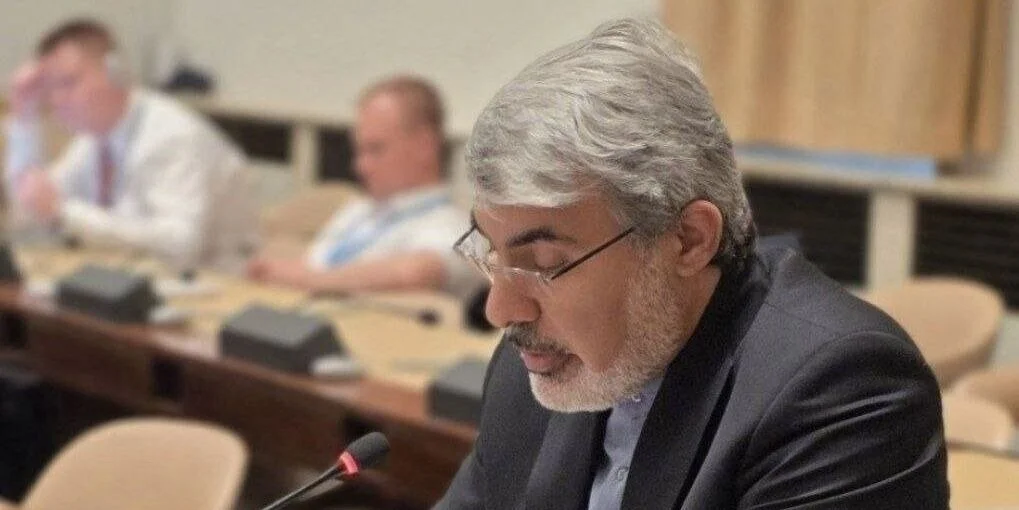
Iran urges UN accountability for US and Israeli actions
Iran's UN envoy Ali Bahreini told the Human Rights Council that US and Israeli actions amount to war crimes and crimes against humanity, calling for accountability.
Published on 22 September 2026
SaveIran urges UN accountability for US and Israeli actions
Iran's permanent representative to the United Nations Office in Geneva, Ali Bahreini, addressed the 63rd session of the UN Human Rights Council in Switzerland on September 21, stating that Iran has faced war, economic coercion, and externally driven unrest over the past year. He called on the international community to take action against what he described as war crimes and crimes against humanity.
Bahreini said that most of the crises Iran suffered, from war to economic hardship, were shaped, fueled, and externally instigated by the United States, with consequences for national sovereignty, social stability, and regional security. He referred to February 28, 2026, as a historic moment, describing acts of aggression by the United States and Israel as marking one of the darkest pages in human history following documented violations of international humanitarian law and human rights. He said Iranians stood before foreign states that showed disregard for international law and no restraint in their brutality, and he noted openly expressed wishes to destroy Iran's civilization and reduce the country to the Stone Age.
He stated that Iran has endured countless trials throughout its history and that its courage in standing firm has shaped it as a resilient people and preserved the greatness of Iran. He said the aggression was transformed into glorious chapters through the bravery of soldiers, the loyalty of the people, and the determination of children who witnessed classmates being torn apart by missiles in their classrooms, to build a greater Iran. During what he called an asymmetric war, Bahreini said the aggressors bombed schools, destroyed power plants, assassinated officials, and targeted civilians. He said the urgent task before the international community is to make the perpetrators of these crimes accountable, adding that collective action today is an investment in the collective future.
Bahreini said the people of Iran are caught between foreign invasion and the economic impacts of unilateral coercive measures (UCMs). He said that in the face of systematic and inhuman coercive measures by the United States, the nation was sustained by its understanding of the adversities, confidence in its own capabilities, and reliance on national strength and resources. He said Iran demonstrated resilience in the face of sanctions, but that this resilience should not absolve the international community of its responsibility to condemn the criminal nature of such measures imposed upon an entire nation.
In conclusion, Bahreini said the January protests in Iran were peaceful at the beginning but immediately evolved into violent unrest amid external interference. He said U.S. officials publicly acknowledged the transfer and smuggling of weapons into Iran for distribution among protesters. The transfer of weapons, together with external provocations, played a significant role in the escalation of the unrest and in the broader sequence of events that preceded the subsequent aggression. Iran maintains that the deliberate use of economic coercion against a whole nation, coupled with external manipulation and militarization of internal unrest, amounts to crimes against humanity, a fact that the Fact-Finding Mission (FFM) fails to address. According to Mehr News, Bahreini made these remarks in his address to the UN Human Rights Council.
Source: Mehr News — Read original story