Iran rejects US claims of arms shipments to Yemen via flights
Iran's UN envoy rejected US allegations that Iranian commercial flights to Sana'a transport arms, calling them baseless and hypocritical, and reaffirmed the humanitarian nature of the flights.
Published on 14 August 2026
SaveIran rejects US claims of arms shipments to Yemen via flights
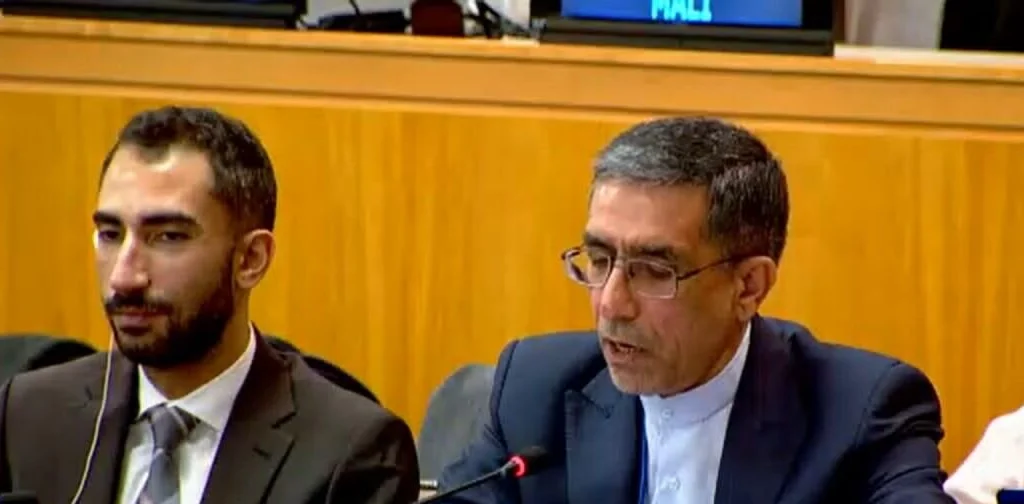
Iran's Ambassador and Permanent Representative to the United Nations, Gholamhossein Darzi, has strongly rejected allegations made by the United States and some other Security Council members that Iranian commercial flights to Sana'a are being used to transport military forces or equipment, in violation of UN Security Council Resolution 2216.
In a letter addressed to UN Secretary-General António Guterres and the President of the UN Security Council, Darzi described the claims as "without any supporting evidence" and "completely baseless." He accused Washington of attempting to mislead the Security Council and called the allegations a "hypocritical" effort to divert attention from its own actions in Yemen and the region, and to evade responsibility for its destabilizing conduct.
Darzi emphasized that the recent flights from Iran to Sana'a have been purely humanitarian in nature. He noted that the prolonged closure and severe restrictions imposed on Sana'a International Airport, along with the blockade, have inflicted devastating humanitarian consequences on the Yemeni population. He said that portraying humanitarian assistance as a destabilizing activity is "factually false as well as morally and legally indefensible."
The Iranian envoy also challenged Washington's claim to be a defender of peace and stability in Yemen, stating that the United States could not credibly assume such a role while seeking to avoid responsibility for the destruction inflicted on the Yemeni people. He pointed out that Yemenis have endured nearly a decade of devastating war, made possible with US political and military support.
Darzi criticized the United States for directly undermining the political process in Yemen, citing US military actions against Yemen in March 2025 that violated the country's sovereignty and territorial integrity, contrary to the UN Charter and Security Council resolutions. He also criticized Washington's efforts to secure political support for Security Council Resolution 2722, adopted in 2024, and its selective and abusive interpretation to justify military action against Yemen and its civilian infrastructure.
He stressed that Iran will continue to support a peaceful, inclusive, and comprehensive political process that is Yemeni-led and Yemeni-owned, under the auspices of the United Nations, as the only viable and sustainable way to resolve the conflict. He called on the international community to engage meaningfully with all relevant Yemeni parties and to address the humanitarian crisis, including lifting the blockade.
Darzi urged the Security Council to reject attempts by some members to use the body for political objectives and instead focus on the suffering of the Yemeni people and support a genuinely Yemeni-owned and Yemeni-led peace process.
The exchange comes amid renewed escalation in Yemen following Saudi airstrikes on Sana'a International Airport last month, which were aimed at halting humanitarian flights carrying patients and stranded civilians. In response, Yemeni forces carried out missile and drone strikes targeting Saudi Arabia's Abha International Airport and announced a naval blockade of Saudi Arabia, aiming to end a 12-year Saudi-led siege of Yemen. Yemeni forces have since announced operations targeting Saudi-linked vessels in the Red Sea, Saudi-backed mercenaries, and Saudi oil facilities.
Saudi Arabia, along with its allies, launched a war on Yemen in March 2015 and imposed a blockade, with military, political, and logistical support from the United States and several Western countries. The war has killed tens of thousands of Yemenis and triggered one of the world's worst humanitarian crises, while Riyadh has failed to achieve its stated objective of restoring a government aligned with its interests in Sana'a. According to Mehr News Agency, the letter and its contents were reported by MNA.
Source: Mehr News — Read original story