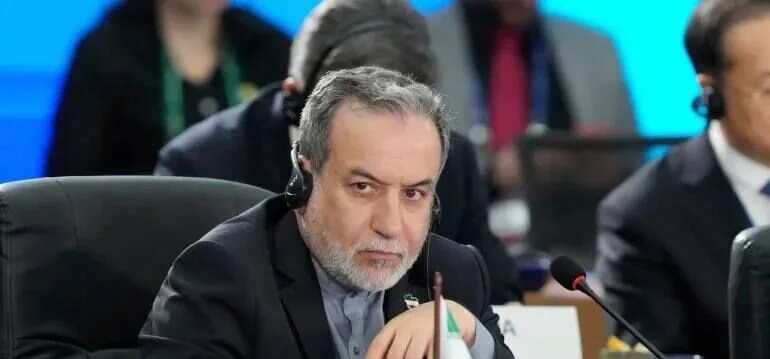
Araghchi tells OIC Iran rejects pressure but remains open to dialogue
Addressing the OIC foreign ministers' meeting in Baghdad, Iran's Foreign Minister Abbas Araghchi said Tehran rejects coercion and threats but will talk if dialogue rests on mutual respect and credible guarantees.
Published on 17 October 2026
SaveAraghchi tells OIC Iran rejects pressure but remains open to dialogue
Iran's Foreign Minister Seyed Abbas Araghchi told the 52nd Council of Foreign Ministers of the Organization of Islamic Cooperation (OIC) in Baghdad that Iran does not accept coercion, threats or intimidation, and that any dialogue must be grounded in mutual respect and backed by credible guarantees. He thanked Iraq for hosting the meeting and congratulated Ismail Ould Cheikh Ahmed on his appointment as OIC Secretary-General, while thanking Turkiya for its chairmanship of the council.
Araghchi said the OIC was founded to give the Islamic Ummah a common voice and that keeping dialogue open is a responsibility rather than a weakness. He cited the OIC Charter's principles of sovereign equality, territorial integrity, non-interference, peaceful settlement of disputes and refraining from the threat or use of force, saying these principles protect all members and lose value when applied selectively. He said Iran has remained committed to international law, the UN Charter and diplomacy over the past two years, while accusing the United States of pursuing aggression, threats, assassination and economic warfare. He said about five thousand people were killed, including hundreds of women and children, and alleged that the United States and Israel assassinated Iran's Supreme Leader and other senior political and military officials. He cited the killing of more than 160 students and teachers in Minab, a cluster-munition attack on the Lamerd stadium, the bombing of a desalination unit in Qeshm and an attack on a wedding ceremony in Kuhestak, Sirik, as documented examples. He thanked member states that expressed solidarity with Iran and called on the organization to stand against attacks on the sovereignty and territorial integrity of a founding member.
Araghchi said Iran defended its people, sovereignty and legitimate interests and would continue to do so, adding that Iran never attacked its neighbors but did attack and destroy US military bases and installations located in the region. He said there is no contradiction between defending rights and pursuing peace, and that the issue will not be resolved on the battlefield. He said Iran remains committed to safe navigation in the Strait of Hormuz, stating that until 28 February 2026 the Strait was open and that disruption since then resulted from US and Israeli actions and US coercive measures and blockade. He said diplomacy had been working: through Pakistan's good offices and with Qatar's support, Iran and the United States signed the Islamabad MoU on 17 June, under whose paragraph 5 Iran undertook to facilitate the safe movement of vessels, and technical discussions with Oman began immediately. Within two weeks, maritime traffic had recovered to about 60 percent of its pre-war level, he said, adding that subsequent unilateral US measures and military action blocked implementation and bypassed the memorandum's dispute-resolution mechanisms. He said Iran has kept the door open and, through Qatar, conveyed a concrete seven-day plan under which the Strait could be reopened and normal maritime passage restored within seven days if conditions are met, adding that the choice now rests with the United States.
On Palestine, Araghchi said the cause remains central to the Islamic world and that Gaza has become a symbol of the failure of international mechanisms to protect civilians. He called for coordinated action to end the killing and blockade and endorsed a proposal by Turkish Foreign Minister Hakan Fidan to designate a Gaza Genocide Memorial Day. On Yemen, he said Iran supports the country's sovereignty, independence, unity and territorial integrity, as well as those of Saudi Arabia, and backs a peaceful, inclusive political process, saying there is no military solution. He said the territory, airspace and infrastructure of every regional state should serve regional security and never be a platform for attacks on a neighbor. According to Mehr News, Araghchi concluded that Iran will not surrender its sovereign rights under pressure but remains ready for dialogue based on mutual respect and credible guarantees.
Source: Mehr News — Read original story