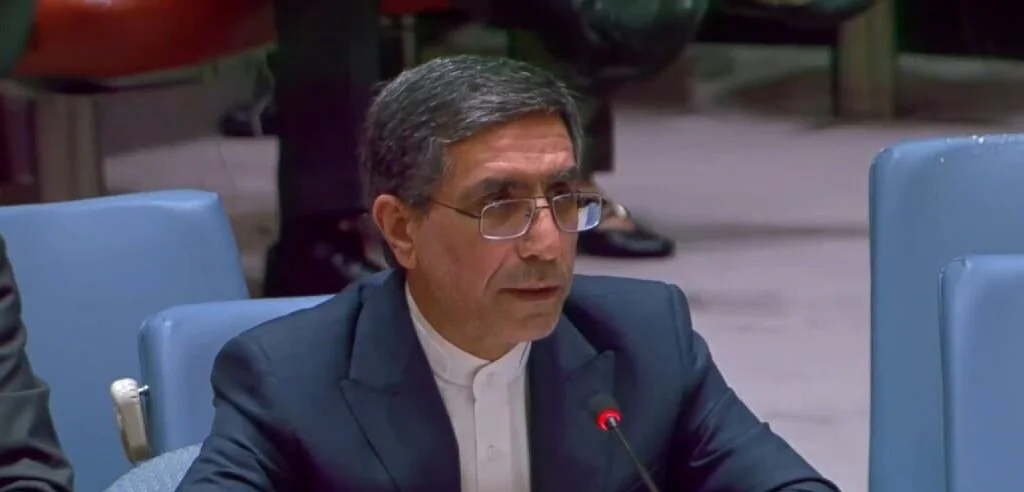
Iran's UN envoy demands UN condemnation of US naval blockade
Gholamhossein Darzi, Iran's chargé d'affaires to the UN, urged the Secretary-General and Security Council president to condemn the US naval blockade as a violation of international law.
Published on 22 October 2026
SaveIran's UN envoy demands UN condemnation of US naval blockade
Iran's ambassador and chargé d'affaires to the United Nations, Gholamhossein Darzi, has called the US naval blockade of Iran a flagrant violation of international law and the UN Charter in a letter addressed to UN Secretary-General Antonio Guterres and the current President of the Security Council, Aglaia Balta. In the letter, Darzi requested that they reject and strongly condemn the continuation of US actions against Iran through the naval blockade, describing it as a clear breach of the UN Charter and international law, including the prohibition on the use of force and respect for Iran's sovereignty and territorial integrity.
The letter states that the US acts of aggression against Iran began on 28 February 2026 and that the subsequent imposition and continuation of an illegal blockade have compounded the grave consequences. It cites repeated threats by the US President to destroy Iran's infrastructure as a grave threat to international peace and security and a violation of Article 2(4) of the UN Charter, as well as the peremptory norm of general international law prohibiting aggression. The letter also refers to a campaign of economic coercion through the so-called "Operation Economic Outcast" and sweeping sanctions targeting Iran's aviation sector and other vital economic sectors, which it says amount to collective punishment prohibited under international humanitarian law and international human rights law.
Darzi argues that the maritime blockade is neither an isolated measure nor merely economic but forms part of the broader context of the original acts of aggression and the continuing use of military force. He cites Article 3(c) of the Definition of Aggression annexed to General Assembly resolution 3314 (XXIX) of 14 December 1974, which qualifies "the blockade of the ports or coasts of a State by the armed forces of another State" as an act of aggression. He states that such acts give rise to Iran's inherent right to self-defense under international law, which continues as long as the blockade is in force. The letter further asserts that the United States cannot evade its international responsibility by replacing direct military attacks with a sustained campaign of military interdiction and economic coercion, and that the obligation to cease wrongful conduct and make full reparation persists.
The letter highlights the humanitarian implications of the blockade, stating that by impeding maritime commerce and disrupting access to essential supplies, it threatens the availability of food, medicines, medical equipment, fuel, agricultural inputs and other goods indispensable to civilian life. It notes that international humanitarian law prohibits the starvation of civilians as a method of warfare and requires the facilitation of humanitarian relief. It also states that restrictions on Iran's civil aviation sector impede access to aircraft, spare parts, maintenance and technical services, thereby exposing passengers and aviation personnel to risks, and that these measures disregard the binding Order of the International Court of Justice of 3 October 2018, which ordered the United States to remove impediments to the free exportation to Iran of goods and services necessary for the safety of civil aviation.
In conclusion, Iran calls upon the Secretary-General and the Security Council President to categorically reject and strongly condemn the continued acts of aggression by the United States through the maritime blockade, to urge the United States to immediately cease its military aggression and lift the blockade, to recognize that the United States remains internationally responsible for its wrongful acts, and to urge all Member States to refrain from recognizing, supporting, facilitating or implementing unilateral coercive measures by the United States that violate international law. The letter emphasizes that accountability for aggression is indispensable to the maintenance of international peace and security and that Iran will pursue all available legal avenues to ensure accountability, reparation and redress. According to Mehr News, the letter was circulated as an official document of the Security Council.
Source: Mehr News — Read original story