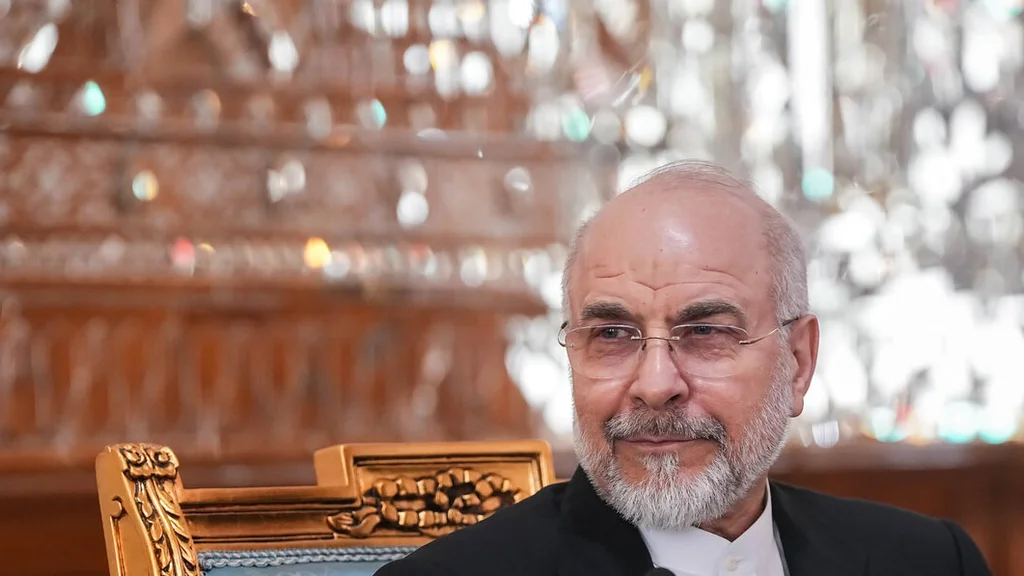
Iran's Parliament Speaker Ghalibaf Calls for Institutionalized Partnership with China on 55th Anniversary of Ties
Mohammad Bagher Ghalibaf, Iran's Parliament Speaker and special representative for Chinese affairs, marked 55 years of Iran-China diplomatic relations by calling for a shift from agreements to implemented projects and a more institutionalized partnership.
Published on 28 September 2026
SaveIran's Parliament Speaker Ghalibaf Calls for Institutionalized Partnership with China on 55th Anniversary of Ties
Mohammad Bagher Ghalibaf, Speaker of Iran's Parliament and the country's special representative for Chinese affairs, issued a written note marking the 55th anniversary of the establishment of diplomatic relations between the Islamic Republic of Iran and the People's Republic of China. In the note, Ghalibaf said the anniversary is not only an occasion to commemorate the past but also to reflect on the future, noting that the world now stands at a different point in its history and that many assumptions underlying the previous international order no longer explain current realities.
Ghalibaf stated that Iran does not seek war but will not surrender to force, and that military and economic superiority does not guarantee the imposition of political will on a determined nation. He said Iran's message is one of peace through mutual respect, and that lasting security takes shape when all countries, large and small, enjoy equal rights to sovereignty, development, and the choice of their own future. He described unilateral sanctions, economic threats, and interference in internal affairs as inconsistent with the United Nations Charter and risky for global security and prosperity.
The Speaker said the era in which a single power or limited group could determine world rules is gradually ending, pointing to Asia's rise as a center of economic activity, technology, and population, and the greater role of Global South countries. He cautioned that multipolarity without fair rules and mutual respect can itself become a source of instability, and called for norms including respect for sovereignty, opposition to double standards, peaceful dispute settlement, and inclusive development. He expressed Iran's interest in President Xi Jinping's vision of building "a community with a shared future for mankind" and China's initiatives on global development, security, civilization, and governance.
Ghalibaf highlighted China's 15th Five-Year Plan, citing its emphasis on high-quality development, scientific and technological innovation, the digital economy, green development, and supply-chain resilience. He said Iran should not be viewed only through oil and gas, pointing to its educated population, scientific and engineering capabilities, energy and mineral reserves, industrial and agricultural capacities, large domestic market, and geographic position connecting Central Asia, the Caucasus, the Persian Gulf, the Sea of Oman, the Indian subcontinent, the Middle East, and Europe. He identified potential cooperation areas including renewable energy, petrochemicals, mining, artificial intelligence, digital economy, pharmaceuticals, medical equipment, agriculture, food security, railways, ports, and logistics.
He said relations have not always progressed in proportion to the two countries' potential, citing administrative complexities, shifting priorities, external pressures, insufficient market knowledge among economic actors, and gaps between political agreements and economic implementation. He said this should be seen as an invitation to institutionalize relations rather than a sign of strategic disagreement, and that the 25-year Comprehensive Cooperation Plan can serve as a framework, but success is measured by projects implemented on the ground. He called for moving from announcing cooperation to implementing it, and from memoranda of understanding to tangible shared economic interests.
Ghalibaf said Iran demonstrated during the recent imposed war that an order based on unilateralism is destined to fail, and that security and prosperity in West Asia are shaped through cooperation with Tehran. He cited the Belt and Road Initiative, the Shanghai Cooperation Organization, and BRICS as opportunities to transform Iran's geographic position into shared economic advantage, including China-Central Asia-Iran rail routes, the North-South Corridor, and joint logistics and production centers. He welcomed long-term investment by Chinese companies, technology transfer, joint ventures, and participation in infrastructure projects, and called for easier travel, more student exchanges, and closer university cooperation. According to Mehr News, Ghalibaf concluded that as the two countries enter the 56th year of diplomatic relations, Iran respects the history of its friendship with China but is focused on building a future in which Asia is a center of peace, development, and cooperation.
Source: Mehr News — Read original story