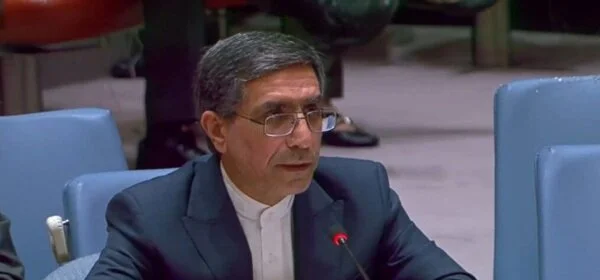
Iran urges continued international engagement with Afghan authorities at UN Security Council
Iran's UN envoy Gholamhossein Darzi told the Security Council that engagement with Afghanistan's de facto authorities is essential, citing security gains and humanitarian needs.
Published on 17 September 2026
SaveIran urges continued international engagement with Afghan authorities at UN Security Council
Iran's Ambassador and Deputy Permanent Representative to the United Nations, Gholamhossein Darzi, addressed a UN Security Council briefing on the situation in Afghanistan on Wednesday, local time, in New York. He congratulated Rabab Fatimah on her appointment as Special Representative of the Secretary-General and Head of UNAMA, and expressed Iran's readiness for close cooperation with her office. Darzi noted that UNAMA plays a vital role in assisting the Afghan people, facilitating dialogue, coordinating international assistance, and promoting a coherent international approach.
Darzi took note of the Secretary-General's latest report (S/2026/724), which he said points to some economic stabilization and efforts by the de facto authorities to maintain governance and economic activity, while also indicating serious challenges including acute humanitarian and economic needs, restrictions affecting women and girls, and the persistent threat of terrorism. He outlined five main points. First, he said that five years after the de facto authorities assumed power, the significant reduction in armed conflict and violence across much of Afghanistan and the relative improvement in the security situation are important gains that must be preserved. However, he warned that ISIL-K and other extremist groups operating in Afghanistan and the region continue to pose a serious threat to Afghanistan and neighboring countries, calling for sustained regional cooperation. He said the Afghan authorities have a responsibility to prevent their territory from being used to plan or carry out terrorist acts against neighboring countries, while the international community and regional countries should support Afghanistan in strengthening its counter-terrorism capacities.
Second, Darzi described the significant reduction in opium poppy cultivation as an important achievement with positive global implications, but noted that its economic impact on rural communities remains severe. He called for sustained investment in alternative livelihoods, rural development, and market access to ensure these gains are durable. Third, he said the humanitarian and economic situation remains deeply concerning, citing declining external assistance, financial and banking constraints, limited investment, and the return of Afghan nationals. He noted that the 2026 Humanitarian Needs and Response Plan remained severely underfunded, with only 29.9 percent ($513 million of the $1.7 billion required) funded. He said humanitarian assistance must be provided on the basis of need and without politicization, and that access to food, medicines, health care and other necessities must not be affected by political considerations. He also called for practical arrangements to facilitate Afghanistan's access to its financial resources and assets, and for greater focus on trade, investment, employment and economic infrastructure.
Fourth, Darzi said that as a neighboring country, Iran closely follows developments in Afghanistan, citing longstanding historical, cultural and human ties and direct implications for regional peace and stability. He said Iran has consistently pursued a practical and neighborly approach, and that despite decades of sanctions and economic pressures, and having recently suffered from US acts of aggression and maritime blockade, Iran has hosted millions of Afghan nationals and provided them with access to education, health care and employment opportunities. He added that Iran has continued to expand economic cooperation with Afghanistan in trade, transit, energy, railways and agriculture, and that further development of trade and transit, including through the capacities of the Port of Chabahar and facilitation for Afghan traders, can provide Afghanistan with greater access to regional and international markets.
Fifth, Darzi said continued international engagement with the de facto authorities remains indispensable to advancing stability and addressing Afghanistan's challenges, and that constructive and principled engagement is the most effective means of encouraging progress in the protection of human rights, including the rights of women and girls and members of ethnic and religious communities. He reiterated Iran's support for continued dialogue and cooperation among Afghanistan, the countries of the region and the international community, and said Iran stands ready to further contribute to regional and bilateral efforts in support of Afghanistan's stability and sustainable development. According to Mehr News, the statement was delivered before the UNSC briefing on the situation in Afghanistan.
Source: Mehr News — Read original story