Information Overload Threatens Human Intellect, Experts Warn
Experts warn that the unprecedented flood of information is eroding deep thinking, literacy, and art, leading to a 'post-literacy era' where passive consumption replaces understanding.
Published on 27 August 2026
SaveInformation Overload Threatens Human Intellect, Experts Warn
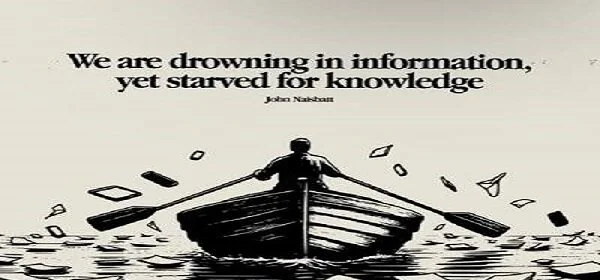
In an era defined by unprecedented access to data, a troubling paradox has emerged: despite having the world's knowledge at our fingertips, human society appears to be growing more superficial and forgetful. This phenomenon, predicted by thinkers decades ago, has become a tangible reality, blurring the line between knowledge and noise.
The human brain, while remarkably adaptable, has limits to its deep processing capacity. When bombarded with excessive data, a destructive cycle begins, termed 'cognitive self-eating.' The brain loses its ability to analyze and organize new information, and due to a lack of 'memory consolidation,' it gradually forgets previously stored knowledge. As a result, people read more but understand less and forget faster.
Global analytical reports indicate that this crisis is not confined to any single region or culture; it is a pervasive, transnational issue. Experts describe the current shift as the 'post-literacy era,' where active readers are replaced by 'passive consumers.' These individuals consume vast amounts of headlines, short messages, and social media posts but lack the ability to comprehend complex texts, analyze lengthy arguments, or connect concepts.
The impact extends to literature and art. Audiences, accustomed to quick dopamine hits from social media, develop tastes for simplistic and easily consumable works. This creates a feedback loop: the market and algorithms push artists to produce shallow content, leading to a new generation of creators whose work lacks depth and meaning. Art, once a sanctuary for deep thought, has become a product of the same noise factory.
To counter this cognitive decline, experts suggest a conscious return to classical principles. This includes reducing screen time, embracing paper media like books and newspapers, and practicing slow, deliberate reading. Unlike social networks, books do not contain notifications or distracting links; they invite 'silence of thought.' By returning to original texts and reading them repeatedly, individuals can re-water the roots of wisdom in their minds.
According to Mehr News, society stands at a civilizational crossroads: choosing between beings with vast accumulations of worthless data and fragmented minds, or patient humans with deep wisdom and coherent thought. Saving thought, art, and literacy is a revolutionary act, beginning with closing a browser tab, putting away a mobile phone, and opening a real book. Wisdom does not grow in the noise of data; it is born in silence and depth.
Source: Mehr News — Read original story