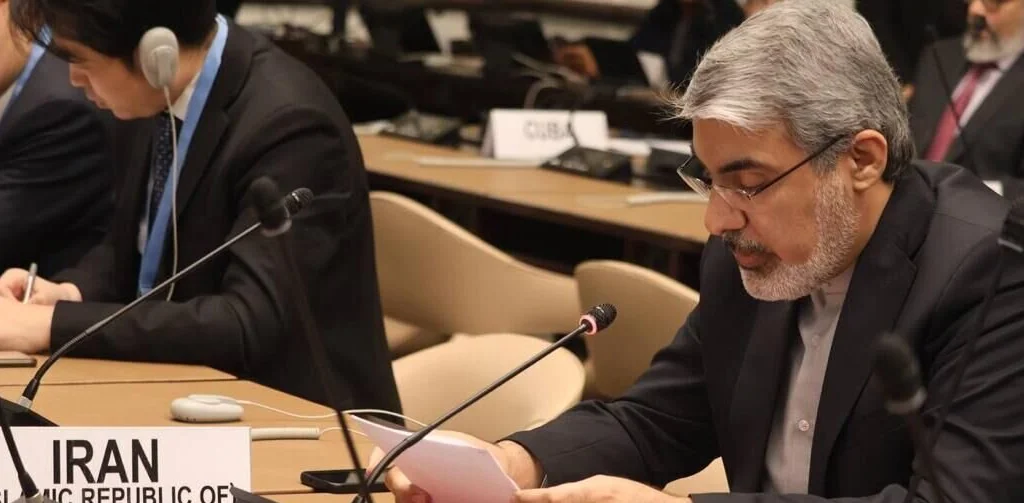
Iran UN envoy says Hormuz economic crisis stems from US-Israeli aggression
Iran's UN envoy Ali Bahreini told UNCTAD that restrictions on Strait of Hormuz transit and their global economic effects are a direct result of US-Israeli aggression and naval blockade, calling for attention to coercive measures' impact on development.
Published on 15 September 2026
SaveIran UN envoy says Hormuz economic crisis stems from US-Israeli aggression
Iran's senior diplomat Ali Bahreini has stated that Iran should not be held responsible for the global economic repercussions of the restrictions it has placed on transit through the Strait of Hormuz, describing the situation as a direct consequence of US-Israeli aggression and a naval blockade. He made these remarks on Monday during the High-Level Segment meeting of the 68th session of the UN Trade and Development Board, known as UNCTAD, held in Switzerland.
Bahreini emphasized that the implications for global development arising from the situation in the Strait of Hormuz cannot be separated from their underlying causes. He pointed to the use of universal coercive measures by countries such as the United States against Iran, which he said have exposed other developing countries to the risk of spillover through trade, energy, food, and other economic channels. According to the Iranian diplomat, the impacts of such measures are not confined to one country and "can weaken development prospects and leave affected economies more vulnerable to additional shocks."
He called for greater global efforts to strengthen the resilience of developing countries against such external shocks. Bahreini urged UNCTAD to give due attention to the cumulative impacts of coercive measures, including aggression and blockade against Iran, on development and economic resilience worldwide.
The meeting took place as part of the 68th session of the UN Trade and Development Board, where member states discuss trade and development issues. Iran has faced longstanding sanctions from the United States, and tensions in the Strait of Hormuz, a vital oil transit route, have raised concerns about global energy supplies. The Iranian envoy's comments highlight the broader economic vulnerabilities that developing nations face when geopolitical conflicts disrupt trade and energy flows.
According to Mehr News, Bahreini's remarks underscore Iran's position that external pressures, rather than its own actions, are responsible for economic disruptions, and he called on the international community to address the root causes of such crises.
Source: Mehr News — Read original story