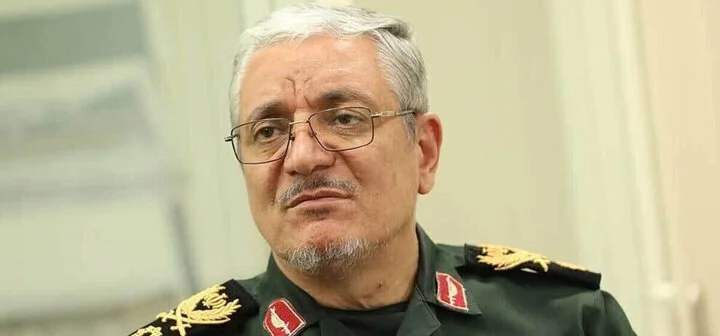
Iran Defense Ministry spokesman says enemy failed to achieve strategic goals in three imposed wars
Brigadier General Reza Talaeinik said the enemy failed to overthrow the Islamic Establishment or divide Iran in the eight-year war, the 12-day war, and the 40-day war. He noted that despite advanced technology, the enemy did not achieve any strategic objectives.
Published on 26 September 2026
SaveIran Defense Ministry spokesman says enemy failed to achieve strategic goals in three imposed wars
Brigadier General Reza Talaeinik, spokesman for Iran's Defense Ministry, spoke at a local ceremony marking eight years of the Sacred Defense, the Iraqi-imposed war against Iran from 1980 to 1988. He said the anniversary of the outbreak of the first imposed war provided an opportunity to compare it with the second and third imposed wars, which he identified as the 12-day war and the 40-day war, to help the younger generation understand the differences in the enemy's patterns, objectives, and methods of confrontation with the Islamic Republic of Iran.
Talaeinik stated that one of the main goals of the enemy in all three stages was to overthrow the Islamic Establishment. Another goal was to divide Iran, and although the geography of targeting differed in different periods, the principle of the goal was followed in all three wars. He also cited geopolitical objectives and efforts to influence Iran's strategic position in the region, particularly given the importance of energy and the location of the Persian Gulf and the Strait of Hormuz, as other common goals of the enemy in these wars.
The spokesman said the enemy failed to achieve any of its strategic objectives. Although the war inflicted costs and damages on the country, the enemy was unable to realize its primary strategic goals, and in contrast, the powerful Armed Forces of the country inflicted heavy costs on the enemy. He pointed to the volume and variety of weaponry used by the enemy in recent conflicts, adding that the intensity of fire, speed of operations, geographical scope of engagement, types of weaponry, and use of new technologies in recent wars are incomparable to the eight-year war.
Emphasizing the necessity of simultaneously strengthening the country's defense capabilities and domestic capacity, Talaeinik stated that to maintain its deterrence, the Islamic Republic of Iran needs to enhance its resilience across various sectors. He highlighted the significant differences between the eight-year war and recent imposed wars, stating that although the enemy entered the battlefield with new objectives and advanced technologies, it failed to achieve any of its strategic goals. Meanwhile, the Islamic Republic of Iran, relying on faith, indigenous defense capabilities, and technological prowess, emerged victorious from this test.
According to Mehr News, Talaeinik's remarks were made during a local ceremony commemorating the eight years of the Sacred Defense, and he underscored the importance of learning from the differences in enemy tactics across the three wars.
Source: Mehr News — Read original story